
Why Circadian Rhythm Habits Drive Your Energy
Most people treat low energy as a caffeine problem. It is usually a timing problem instead. Your body runs on an internal roughly 24-hour clock, and building consistent circadian rhythm habits does more for sustained, all-day energy than almost any supplement or productivity hack you could add on top of a misaligned schedule.
The circadian system, first mapped in detail by researchers studying circadian rhythms on Wikipedia, governs far more than sleep. It regulates core body temperature, hormone release, digestion, and alertness in predictable daily waves. When your habits fight that wave, you feel foggy at 10 a.m. and wired at 11 p.m. When your habits work with it, energy becomes far more consistent and far less dependent on how much coffee you drink. A useful mental model: think of your body as running dozens of smaller clocks, one for digestion, one for hormone release, one for core temperature, all normally synchronized by the master clock in your brain, and most "low energy" complaints are really a symptom of those smaller clocks drifting out of sync with each other.
Habit One: Anchor Your Wake Time, Not Your Bedtime
The single most powerful circadian rhythm habit is a fixed wake time, seven days a week, including weekends. Your wake time is the anchor that your entire internal clock references; a consistent bedtime is far less influential than a consistent wake time, which surprises most people.
Pick a wake time you can realistically sustain, even on Saturdays, and hold it within a 30-minute window. Within two to three weeks, you will likely notice you start waking up naturally, slightly before your alarm, which is a reliable sign your internal clock has stabilized around that anchor.
Habit Two: Get Bright Light Within 30 Minutes of Waking
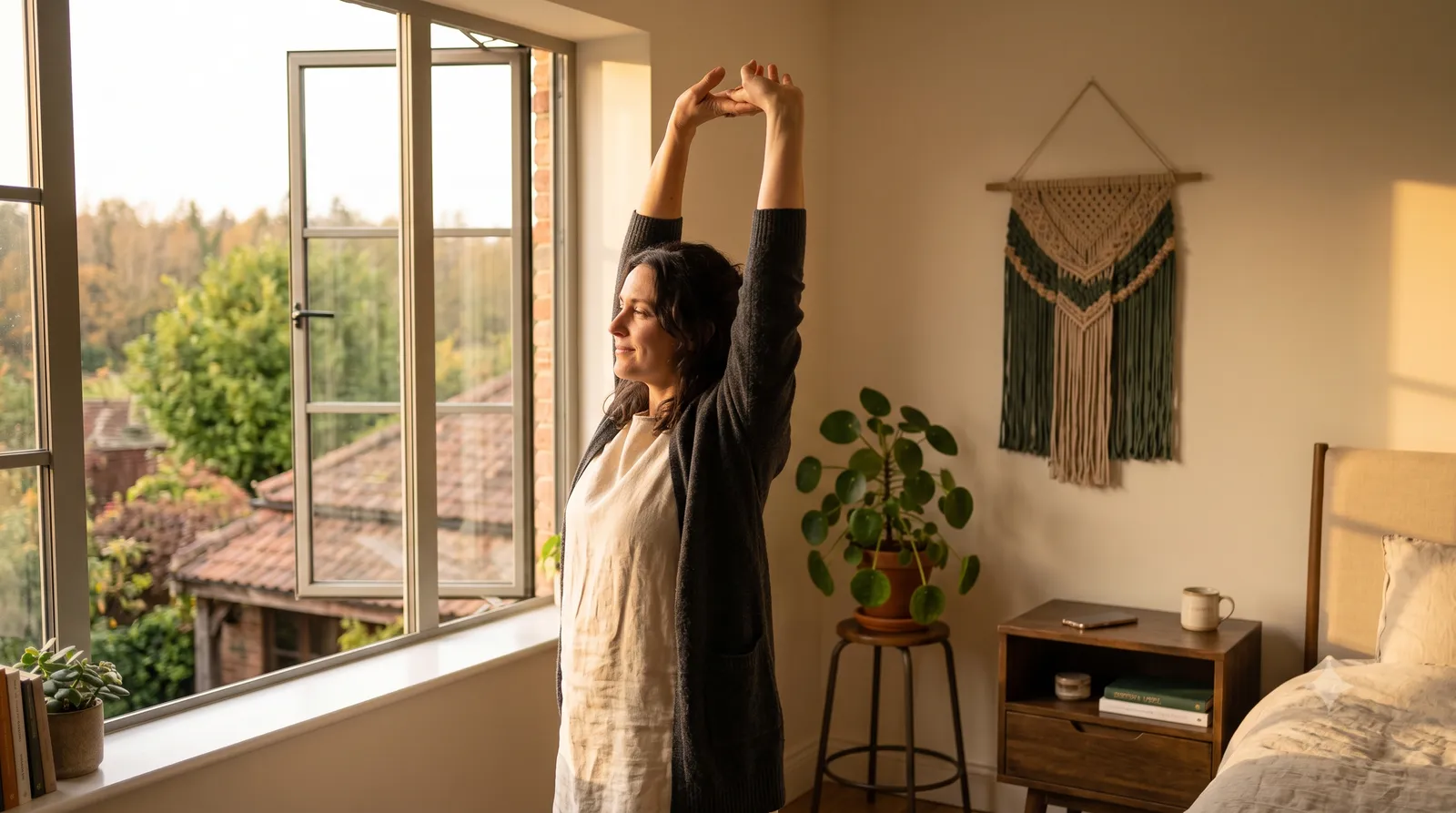
Light is the single strongest signal your circadian system uses to set its clock each day, stronger than food, stronger than exercise, stronger than temperature. Aim for 10 minutes of outdoor light within 30 minutes of waking, even on cloudy days, since outdoor light is dramatically brighter than typical indoor lighting. Even a heavily overcast sky delivers roughly 1,000 to 2,000 lux, compared to a typical indoor room's 100 to 300 lux, which is why standing by a closed window is a poor substitute for actually stepping outside.
This habit pairs directly with a screen-free morning routine, since stepping outside for light exposure naturally displaces the urge to reach for a phone first thing. The two habits reinforce each other rather than competing for the same few minutes.
- Step outside within 30 minutes of waking, rain or shine
- Aim for 10 minutes minimum, longer on overcast days
- Skip sunglasses during this window if it is safe to do so
- Pair it with a short walk to also get light movement
Habit Three: Time Your Caffeine Strategically
Most people drink coffee the moment they wake up, which is precisely when the body's natural cortisol surge is already peaking, meaning caffeine adds relatively little at that exact moment. Delaying your first cup by 60 to 90 minutes lets natural cortisol do its job first, and caffeine then extends alertness later, instead of overlapping with it.
Equally important is your last caffeine cutoff. Caffeine has a half-life of roughly five to six hours in most adults, so a 3 p.m. coffee can still have meaningful levels in your system at 9 p.m., quietly degrading sleep quality even if you feel fine falling asleep. A safe general cutoff is eight hours before your target bedtime. For a concrete example, if you plan to be asleep by 10:30 p.m., your last cup of coffee, including espresso-based drinks, should realistically land before 2:30 p.m.; many people who insist caffeine "doesn't affect" their sleep are actually falling asleep fine but sleeping in a lighter, more fragmented stage than they would otherwise, which shows up the next day as grogginess rather than obvious insomnia.
Habit Four: Eat on a Consistent Window
Meal timing is a secondary but real circadian rhythm habit. Eating your meals within a roughly consistent daily window, and avoiding large meals within two to three hours of bedtime, helps keep your digestive and metabolic clocks synced with your sleep-wake clock. Erratic meal timing sends conflicting signals to different internal clocks that are normally synchronized.
You do not need a strict intermittent fasting protocol for this benefit. Simply eating breakfast, lunch, and dinner at roughly the same times most days, within an hour or so, captures most of the circadian benefit without requiring rigid rules that are hard to sustain long term.
Habit Five: Schedule Demanding Work Around Your Energy Curve
Most adults experience a natural alertness peak in the late morning, a dip in early-to-mid afternoon, and a smaller secondary peak in early evening. Fighting this curve by scheduling your hardest cognitive work during the afternoon dip is a common, avoidable source of daily fatigue. This pattern is sometimes called your ultradian or circadian energy curve, and while the exact timing shifts a little person to person, depending on whether you are more of a natural early riser or a natural night owl, the general late-morning-peak, afternoon-dip shape holds for the large majority of adults regardless of chronotype.
Instead, map your actual energy against your calendar for one week, then shift your most demanding tasks into your natural peak. This is essentially applying daily time blocking and the 3-priority rule with circadian timing layered on top, so your hardest work lands when your brain is naturally most capable, not when your calendar happens to be free.
- Track your energy hourly for one work week, on a 1-5 scale
- Identify your consistent peak and dip windows
- Move your top-priority task into the peak window
- Reserve the dip window for admin, email, or a short walk
Habit Six: Dim Lights and Limit Screens Before Bed
In the two hours before bed, your circadian system is highly sensitive to bright and blue-toned light, which suppresses melatonin release and delays your body's natural signal that it is time to wind down. Dimming overhead lights and switching to warmer lamp lighting in the evening is a simple, low-effort circadian rhythm habit with an outsized effect on sleep onset.
This is where a low-dopamine evening routine becomes relevant too, since reducing stimulating screen content in the evening supports both circadian alignment and calmer, less activated sleep onset. When I tested a strict 9 p.m. dim-lights rule myself, I fell asleep noticeably faster within the first week, without changing anything else about my routine.
Habit Seven: Protect Weekend Consistency to Avoid Social Jet Lag
Sleeping in significantly on weekends creates a real phenomenon researchers call social jet lag, where your internal clock shifts similarly to crossing time zones, then has to re-adjust every Monday. This is one of the most underrated circadian rhythm habits to fix, because most people do not realize weekend sleep patterns are actively sabotaging their Monday energy.
A practical compromise: allow yourself up to one extra hour of sleep on weekends, not three or four, and keep your light exposure and meal timing roughly consistent even if your wake time shifts slightly. This protects most of the recovery benefit of weekend rest without triggering a full circadian reset. A simple way to check whether you are managing this well: if you regularly need two or three cups of coffee just to feel normal on Monday and Tuesday but feel fine by Wednesday, that pattern is a strong sign of social jet lag rather than a normal, unavoidable case of "the Mondays."
Troubleshooting Circadian Rhythm Habits With an Irregular Schedule
Not everyone can anchor a fixed wake time. Shift workers, new parents, and people with rotating on-call schedules often read advice like this and reasonably conclude none of it applies to them. It applies, it just needs a different anchor than clock time.
If your wake time genuinely changes every few days, anchor your first light exposure and first meal to the moment you wake up instead, no matter what the actual clock says. Keeping the sequence, light shortly after waking, a meal within the first hour or two, consistent even when the clock time shifts, preserves most of the circadian benefit that a fixed schedule would otherwise provide. For night-shift workers specifically, wearing dark sunglasses on the commute home and using blackout curtains to simulate night during daytime sleep are two of the highest-leverage adjustments available, since bright morning sunlight on the drive home is one of the strongest possible signals telling your body it is time to be awake, exactly when you are trying to fall asleep.
- Shift workers: anchor light and meals to wake-up moment, not clock time
- Wear dark sunglasses on the commute home after a night shift
- Use blackout curtains and a sleep mask for daytime sleep
- New parents: protect even 5 minutes of morning light when a full routine isn't possible
- Frequent travelers: seek morning light in the new time zone immediately on arrival
Frequently Asked Questions
What are circadian rhythm habits, in simple terms?
Circadian rhythm habits are daily behaviors, like consistent wake times, morning light exposure, and timed meals, that keep your internal 24-hour body clock aligned. When aligned, they produce more stable energy, better sleep, and steadier mood throughout the day.
How long does it take to reset your circadian rhythm?
Most people notice meaningful improvement within one to two weeks of consistent habits, with full stabilization typically taking three to four weeks. Consistency, especially a fixed wake time and morning light exposure, matters more than any single dramatic change.
Does caffeine timing really affect circadian rhythm and energy?
Yes. Caffeine has a half-life of five to six hours, so afternoon caffeine can still be active in your system at bedtime, disrupting sleep quality even without a conscious feeling of being wired. Delaying your first coffee slightly and cutting off caffeine roughly eight hours before bed both support better alignment.
Can circadian rhythm habits help with afternoon energy crashes?
Yes, significantly. A large portion of the mid-afternoon slump comes from a natural circadian dip combined with poor light exposure and inconsistent meal timing, all of which are directly addressable through the habits described above rather than requiring more caffeine or sugar.
Do I need to wake up at 5 a.m. to fix my circadian rhythm?
No. What matters is consistency, not an early wake time specifically. Waking at 7:30 a.m. every day, including weekends, is far more circadian-friendly than waking at 5 a.m. on weekdays and 10 a.m. on weekends.
Is it too late to fix a disrupted circadian rhythm from shift work or jet lag?
It is rarely too late, though recovery may take longer for shift workers or after long-haul travel. Anchoring light exposure, meal timing, and wake time as consistently as your schedule allows will still meaningfully improve alignment, even in non-ideal circumstances.