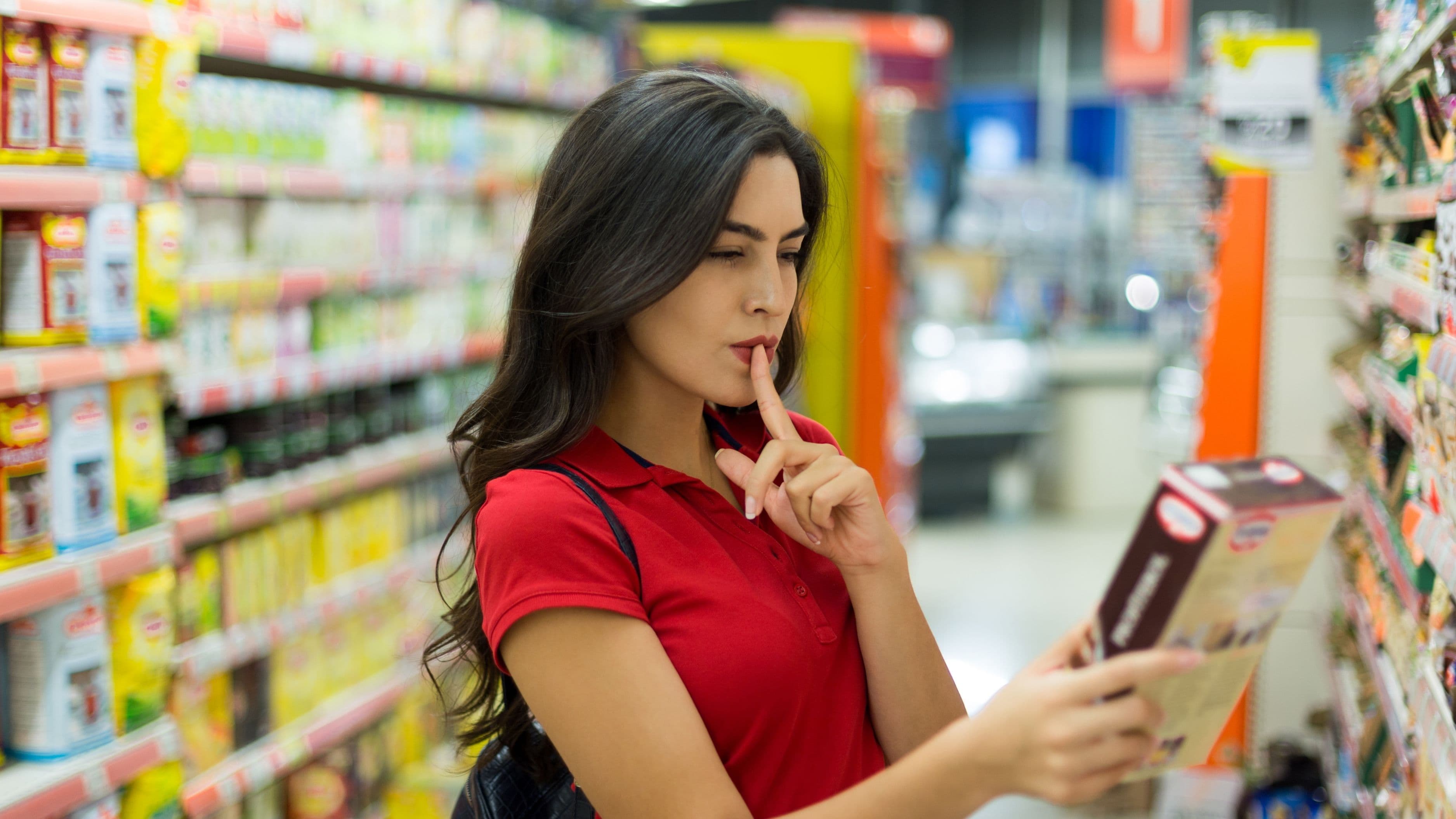
The good news is that once you know what to look at and what to ignore, reading a food label takes about 30 seconds and tells you most of what you need to know. You don't need a nutrition degree. You just need a simple system.
Why Food Labels Are Confusing on Purpose
It helps to start by acknowledging something: food packaging is designed by marketing teams, not nutritionists. Claims on the front of a package are largely unregulated and can be misleading without technically lying. "Made with whole grains" can appear on a product where refined flour is the primary ingredient and whole grain is barely present. "Low sugar" means less sugar than the regular version, which might still be substantial. "Natural" has no official definition in the US and can appear on almost anything.
This isn't to make you suspicious of everything, but to shift your attention from the front of the package to the back. The Nutrition Facts panel and the ingredients list are where real information lives, and they're governed by actual labeling regulations. That's where this guide focuses.
Step 1: Start With the Serving Size
Before you look at any number on a nutrition label, check the serving size listed at the top. Everything else on the label – calories, fat, sodium, sugar – refers to that specific serving amount, not the whole package.
This is where a lot of confusion happens. A bag of chips might say 150 calories per serving, but if the serving size is 12 chips and the bag contains three servings, you're looking at 450 calories if you eat the bag. A bottle of iced tea might list 90 calories per serving with 2.5 servings per bottle – which most people drink in one sitting. Food manufacturers are allowed to set their own serving sizes, and they have a strong incentive to keep them small so the numbers look favorable.
The fix is simple: before reading any other number, find the serving size and ask yourself whether that matches how much of this food you'd actually eat at once. If it's half a serving or three servings, adjust everything proportionally in your head.
Step 2: Don't Obsess Over Calories – Look at What the Calories Are Made Of
Calorie counts matter, but they don't tell the whole story. 200 calories from almonds and oats behaves differently in your body than 200 calories from refined sugar and white flour. What those calories are made of matters more for how you feel, how long you stay full, and what effect the food has on your energy and health.
The three things worth checking in the middle of the label are added sugar, fiber, and protein. Added sugar (listed separately from total sugar since 2020 on most US labels) is the one that trips up most people – it shows up in foods you wouldn't expect, like pasta sauce, salad dressing, bread, and yogurt. Fiber and protein both slow digestion, help you stay satisfied longer, and are generally markers of a more nutritious food. A product with meaningful fiber and protein and low added sugar is generally a better option than one with the inverse, regardless of what the front packaging says.
For fat and sodium, context matters. Not all fats are the same – unsaturated fats from nuts, seeds, and olive oil are beneficial, while saturated fat and trans fat warrant more attention. Sodium is worth checking if you're eating multiple processed foods in a day, since it accumulates fast across meals.
Step 3: Read the Ingredients List Like It's a Story
The ingredients list is often more informative than the nutrition facts panel, and it's worth learning to read it with a few simple principles.
Ingredients are listed by weight, from most to least. Whatever appears first is what the product contains the most of. If the first three ingredients in a "whole grain" cereal are refined corn flour, sugar, and corn starch – with whole grain oats appearing fourth – you're looking at a product that's mostly refined grain with a marketing claim on the front. The position of an ingredient tells you how significant it actually is.
Sugar has many names. Manufacturers sometimes split sugar across multiple ingredient names to push each one lower on the list, making the product appear less sugary. Common aliases include high-fructose corn syrup, cane juice, maltose, dextrose, sucrose, brown rice syrup, and agave nectar. If you see several of these in the ingredients list of the same product, the total sugar content is higher than any single line item suggests.
Shorter lists are usually better. A product with five recognizable ingredients is generally more straightforward than one with thirty, many of which are additives, thickeners, and preservatives. This isn't a universal rule – there are complex foods with many ingredients that are perfectly fine – but it's a useful general heuristic. If you can't recognize most of the ingredients, it's a signal to look more carefully at the nutrition panel.
"Enriched" flour means stripped-then-restored. When you see "enriched wheat flour" or "enriched flour" in an ingredients list, it means the grain was refined (removing the fiber-rich bran and nutrient-dense germ), then had a few synthetic vitamins added back. It's nutritionally inferior to whole grain flour, and the "enriched" label makes it sound like an improvement when it's really a partial restoration. Whole wheat flour or whole grain oats listed first is genuinely different.
Step 4: Understand the Front-of-Package Claims
Now that you have the tools to read the back of the package, the front becomes much easier to interpret. Here are the most common claims and what they actually mean:
"Natural" has no regulated definition in the US. It can appear on products with artificial ingredients, preservatives, and synthetic additives. It tells you nothing meaningful about the product's nutritional quality.
"Made with whole grains" can legally appear even if whole grain is a minor ingredient. Check the ingredients list to see where whole grains actually appear and whether they're the primary grain or a minor addition.
"Low fat" means the product meets a specific fat threshold, but low-fat versions of foods often compensate by adding sugar or refined carbohydrates to improve taste. Check the added sugar on a low-fat yogurt, for example, and compare it to a full-fat version.
"Reduced sugar" or "light" means less of that nutrient compared to the regular version, but the baseline might still be high. A "reduced sugar" juice drink might still contain 20 grams of sugar per serving.
"High in fiber" is a more meaningful claim than most because it's regulated – a product needs to contain at least 5 grams of fiber per serving to use it. It's one of the front-of-package claims actually worth paying attention to.
"Organic" is a regulated certification that refers to farming practices – avoiding synthetic pesticides, GMOs, and certain additives. It doesn't automatically mean a product is nutritionally superior, but it does mean what it says in terms of production standards.
Step 5: Build a 30-Second Label Habit
The goal isn't to spend five minutes analyzing every product in the grocery store. It's to build a quick, automatic scan that gives you the most important information in the time it takes to put something in your cart.
Here's a simple sequence that works: flip to the back, check the serving size first, scan added sugar and fiber in the nutrition panel, then glance at the first three to five ingredients. That's the whole system. If the serving size is realistic, added sugar is low, there's meaningful fiber, and the first ingredients are recognizable whole foods – you've got a good product regardless of what the front says.
With a little practice, this becomes instinctive. You'll stop being drawn in by "made with real fruit" on a snack that lists sugar and refined flour before any actual fruit appears. You'll notice when a yogurt labeled "healthy" has more added sugar than a candy bar. None of this requires obsession or anxiety – just a quick habit that filters signal from noise.
Common Mistakes to Avoid
Trusting the front of the package without checking the back is the main one, and this guide has covered why. The front is advertising. The back is information.
Comparing only calories between two products without looking at what those calories are made of leads to poor trade-offs. A 100-calorie pack of crackers made from refined flour and oil isn't equivalent to 100 calories of actual nuts, even though the number is identical.
Ignoring serving size math is where many people underestimate what they're eating. Getting used to noting the serving size before reading anything else is a habit that changes how you interpret labels immediately.
Treating "low" versions of foods as automatically better is a trap worth naming. Low-fat, low-calorie, and low-sugar versions of products frequently replace what's removed with something else that isn't necessarily better. Always check the full label of a "healthier" version against the original before assuming it's the smarter choice.
FAQ
Do I need to check labels on whole foods like fruit and vegetables? No – unpackaged whole foods don't have nutrition labels, and they don't need one. Fresh fruit, vegetables, eggs, and plain meat are straightforward. Labels become relevant for packaged, processed, and prepared foods where ingredients and additives are involved.
How do I quickly identify added sugar in a product? In the US, "added sugars" has been a required line item on Nutrition Facts panels since 2020 for most products, listed separately from total sugar. If you're outside the US, look for sugar, syrup, juice concentrate, or any ingredient ending in "-ose" (glucose, fructose, sucrose, dextrose) in the ingredients list.
Is the % Daily Value on labels useful? It can be, for a rough reference. The % DV is calculated based on a 2,000-calorie daily diet, which doesn't match everyone's actual needs. A general rule: 5% DV or less is considered low, 20% DV or more is considered high. For nutrients you want more of (fiber, protein, vitamins), higher is better. For nutrients you want less of (sodium, saturated fat, added sugar), lower is better.
Should I avoid all processed foods? Not necessarily. "Processed" covers a wide spectrum – canned beans, frozen vegetables, plain yogurt, and whole grain bread are all technically processed. The category to be more mindful of is ultra-processed foods – products made primarily from industrial ingredients with little resemblance to whole food – rather than all packaged food. The ingredients list is the most useful tool for making that distinction.
How long does it take to get comfortable reading labels? Most people find that after checking labels consistently for two to three weeks, the main signals become automatic. You stop reading every ingredient and start scanning for the key markers – serving size, added sugar, fiber, and the first few ingredients. It becomes a quick, low-effort habit rather than a detailed analysis.
📚 Sources
US Food and Drug Administration – How to Understand and Use the Nutrition Facts Label: https://www.fda.gov/food/new-nutrition-facts-label/how-understand-and-use-nutrition-facts-label
Harvard T.H. Chan School of Public Health – Interpreting Nutrition Research: https://www.hsph.harvard.edu/nutritionsource/nutrition-news/
Center for Science in the Public Interest – Food Labeling and Marketing: https://www.cspinet.org/eating-healthy/food-labeling
NHS – Food Labels Explained: https://www.nhs.uk/live-well/eat-well/food-guidelines-and-food-labels/food-labelling-terms/
American Heart Association – Understanding Food Nutrition Labels: https://www.heart.org/en/healthy-living/healthy-eating/eat-smart/nutrition-basics/understanding-food-nutrition-labels