
You don't need to become a gymnast or a yogi. You don't need an hour a day. What you need is about 10–15 minutes of stretching done consistently, a basic understanding of what actually works, and realistic expectations about what 30 days can deliver. This challenge covers all of it.
What Actually Happens When You Stretch
Before getting into the plan, it helps to understand what's actually changing when you stretch regularly – because it explains why consistency matters more than intensity.
When you hold a stretch, you're not permanently lengthening muscle fibers in the way some people imagine. What's actually happening is more interesting. In the short term, your nervous system is learning to tolerate a position it previously found uncomfortable. That "tightness" you feel in a stretch is often more about your nervous system sending a protective signal than your muscles being physically shortened. Over time, consistent stretching trains your nervous system to relax in positions it initially resisted.
Longer-term changes also happen at the structural level – connective tissue (tendons, ligaments, fascia) gradually adapts to regular loading at end ranges of motion, becoming more pliable and less likely to resist movement. These structural changes take longer than the nervous system adaptations, but both are happening simultaneously across a 30-day period. This is why people often notice significant improvement in the first two weeks and then feel like progress slows – the easy nervous system gains have been made, and the structural work is happening more gradually.
What 30 Days Can Realistically Deliver
Being honest about expectations matters here. Thirty days of consistent daily stretching will not make an inflexible person flexible by any absolute standard. What it will do is produce noticeable, measurable improvement in the specific areas you target, reduce the muscular tightness that accumulates from sitting and inactivity, and build a habit that compounds significantly if you continue beyond the 30 days.
Most people who complete this challenge notice they can reach further in forward folds, feel less tightness in their hips and lower back after long periods of sitting, and find that exercises they previously found uncomfortable become more accessible. These are meaningful quality-of-life improvements, not just athletic numbers. If you want to see how much you've changed, measure yourself on day one – how close you can get to touching your toes in a standing forward fold, how far your hips drop in a low lunge – and check again on day 30.
The 30-Day Challenge Plan
This plan is organized into four weekly phases. Each phase builds on the last, gradually introducing more challenging positions and longer hold times as your body adapts. The daily time commitment starts at 10 minutes and builds to 15. You don't need any equipment.
Week 1: Build the Habit (Days 1–7)
The goal in week one is simply to show up every day and establish the routine. Don't push hard. Don't try to force range of motion. Hold each stretch at the point where you feel mild tension, not pain, and focus on breathing slowly throughout.
Daily Routine (10 minutes):
Standing forward fold – Stand with feet hip-width apart, hinge forward from the hips, and let your hands drop toward the floor. Don't force them down – just let gravity do the work. Hold for 30 seconds, letting your spine relax. This targets hamstrings and lower back.
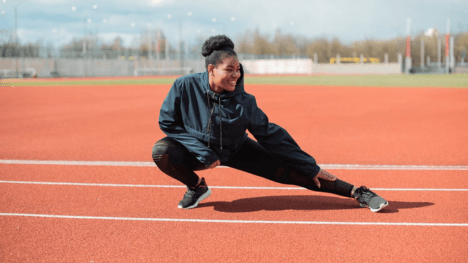
Low lunge (each side) – Step one foot forward into a lunge, drop the back knee to the floor, and sink your hips forward and down. Place hands on the front knee for support. Hold for 30 seconds per side. This targets hip flexors, which are tight in almost everyone who sits during the day.
Seated figure-four stretch (each side) – Sit in a chair, cross one ankle over the opposite knee, and gently press down on the raised knee while leaning slightly forward. Hold 30 seconds per side. This targets the piriformis and outer hip.
Doorway chest stretch – Stand in a doorway, place your forearms on the frame at 90 degrees, and gently lean through. Hold 30 seconds. This targets the chest and shoulders.
Supine spinal twist (each side) – Lie on your back, bring one knee to your chest, then guide it across your body to the floor while extending the same-side arm out to the side. Hold 30 seconds per side. This targets the lower back and thoracic spine.
Rest in child's pose for a minute to finish – knees wide, forehead down, arms extended, breathing slowly.
Week 2: Add Hold Time (Days 8–14)
You've built the habit. Now extend each stretch hold from 30 seconds to 45–60 seconds. This is where a lot of the nervous system adaptation happens – slightly longer holds give your body more time to relax into the position instead of just bracing against it.
Add one new stretch to the routine:
Butterfly stretch – Sit on the floor, bring the soles of your feet together, let your knees fall open. Hold your feet and gently lean forward from the hips. Hold 45–60 seconds. This targets the inner groin and hips.
Your total routine is now around 12 minutes. Continue every day.
Week 3: Introduce Progressive Depth (Days 15–21)
By week three, you'll likely notice you can get further into some of the week-one stretches than you could on day one. Use that increased range – but don't force it. Work to about 70–80% of your comfortable limit, not to the edge.
Add two new stretches:
Standing quad stretch (each side) – Stand on one leg, bend the other knee and hold your ankle behind you. Keep knees together and hips level. Hold 30 seconds per side. This targets the quadriceps and hip flexors.
Seated hamstring stretch (each side) – Sit on the floor with one leg extended and one bent. Reach toward the extended foot, keeping your back straight rather than rounding. Hold 45 seconds per side.
Your routine is now around 15 minutes. The longer duration is intentional – by week three your body can handle more volume, and the deeper stretches take time to settle into.
Week 4: Consolidate and Test (Days 22–30)
The final week is about consistency and consolidation. Keep the full routine from week three, but start to notice how your body feels in each position compared to week one. You're not trying to add more stretches – you're building on what you've established and making space for the improvements to settle in.
On day 30, run through the same assessment you did on day one. Stand forward fold – how far down can you reach? Low lunge – how low can your hips sink? These are your progress markers. Write them down.
If you've been consistent, the differences will be real. Not dramatic, but real and measurable – which is exactly what 30 days of intentional practice looks like.
Tips for Making This Work
Morning or evening both work – pick the one you'll actually do. Morning stretching when muscles are cold feels tighter; evening stretching after the day's movement feels easier. Neither is wrong. Consistency matters more than timing.
Don't bounce. Ballistic stretching (bouncing at the end of range) triggers a protective reflex that actually works against flexibility. Hold positions steadily and breathe through them.
Warmth helps. Stretching after a warm shower, or after 5 minutes of light movement (walking, marching in place), produces better results than stretching cold from a sitting position. A warm body is a more pliable body.
Breathe into the stretch, not against it. Holding your breath creates tension. Long, slow exhales help your nervous system relax into the position. If you're holding your breath, you're working too hard.
Mistakes to Avoid
Pushing to pain. Flexibility training works best at the edge of mild discomfort, not at sharp or intense pain. If something hurts acutely, you've gone too far. Back off and work at a depth where you feel tension but not distress.
Skipping days and "catching up" with longer sessions. Consistency beats occasional intensity every time with flexibility training. A 10-minute session seven days a week produces better results than a 70-minute session once a week.
Expecting week-four results in week one. The nervous system adaptations that produce big early improvements happen in the first two weeks. After that, progress is slower and harder to perceive day-to-day, which is normal. This doesn't mean you've plateaued – it means the structural work is happening.
Only stretching your "problem areas." Flexibility is connected across the whole body. Tight hips affect the lower back. Tight hamstrings affect the hips. Working the full-body routine rather than just targeting one spot produces better overall results.
FAQ
How long does it take to see real flexibility improvements? Most people notice meaningful improvement within two weeks of daily stretching, particularly in the areas they're targeting consistently. By day 30, the changes are typically measurable. Continued improvement beyond 30 days happens, but the rate of change slows as you progress – the first 30 days tend to produce the most noticeable gains.
What if I miss a day? Just pick up where you left off the next day. Don't add extra time or try to "make up" for the missed session. The habit matters more than the perfect record. Missing one day in 30 doesn't significantly affect your results.
Is it better to stretch before or after exercise? For this challenge, stretching at any point in the day is fine. As a general principle, static stretching (holding positions) is most beneficial after a workout or on its own, when muscles are warm. Before a workout, dynamic warm-up movements (leg swings, hip circles) are preferable to static holds.
Can stretching every day cause injury? Daily gentle stretching at appropriate intensity is very safe for most people. The key is holding at mild tension rather than pain, and not bouncing or forcing range. If you have a specific injury or medical condition affecting your joints or muscles, check with a healthcare provider before starting any new flexibility program.
Will I lose my flexibility gains if I stop stretching? Yes, gradually. Flexibility is a use-it-or-lose-it quality – consistency is what maintains it. The good news is that reaching maintenance doesn't require the same daily commitment as building it. Three or four sessions per week is usually sufficient to maintain the range of motion you've developed.
📚 Sources
American College of Sports Medicine – Flexibility training guidelines: https://www.acsm.org/education-resources/trending-topics-resources/physical-activity-guidelines
Journal of Human Kinetics – Effects of static stretching on flexibility: https://www.ncbi.nlm.nih.gov/pmc/articles/PMC3588693/
Harvard Health Publishing – The importance of stretching: https://www.health.harvard.edu/staying-healthy/the-importance-of-stretching
National Academy of Sports Medicine – Static vs dynamic stretching explained: https://blog.nasm.org/fitness/static-vs-dynamic-stretching
Mayo Clinic – Stretching: focus on flexibility: https://www.mayoclinic.org/healthy-lifestyle/fitness/in-depth/stretching/art-20047931